Age and Discrimination – Ageism (agism), is defined as prejudice or discrimination on the grounds of a person’s age. Though ageism can occur on the other end of the age spectrum, in Age and Discrimination – Ageism – Yes Sadly It Still Exists, I address age discrimination and the older adult.
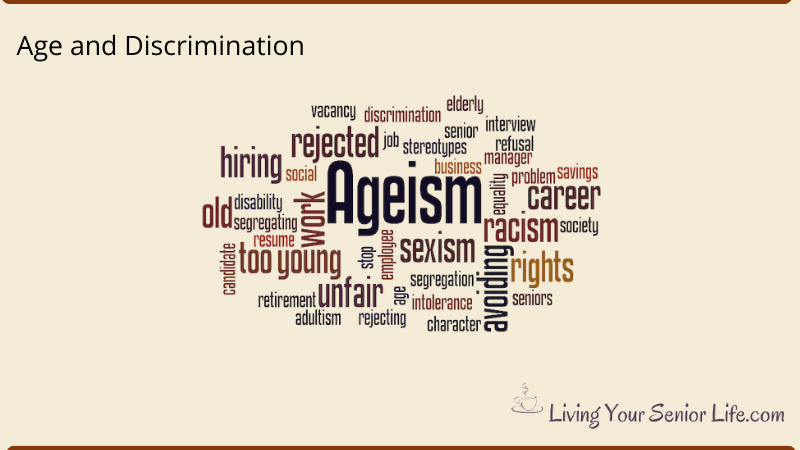
After reaching a certain age, have you noticed a change in how you are treated? Maybe you’ve been looked over for a new job or a new position at your current job. Maybe a sideways look at the gym makes you feel like you shouldn’t even be there. Has a doctor commented, “you’re not as young as you once were?” What about age-related jokes? These are all examples of ageism.
If the examples above had been brought about with a different population segment, it would be treated with contempt and outrage. But for some reason, age discrimination seems to be acceptable.
So many times when you hear of someone describing a senior, you may hear: cranky, bad driver, feeble, rude, grumpy, slow, geezer, technically illiterate, ultra-conservative, stay off my grass kind of guy.
Occasionally, you may hear some positive descriptions such as wise or nice, but more often than not, it is a negative stereotype description that is used.
I argue that though these descriptions, both positive and negative, can be true of someone older, they can also be used to describe a younger person.
Video: Age Discrimination – Ageism

Job Discrimination and Age – Do They Go Hand in Hand?

We have all heard the familiar story: Two job applicants who are both qualified and apply for the same job or promotion, and the job is awarded to the younger applicant.
What about the loyal older worker who has been preparing for a much-anticipated promotion. He has been on time, rarely calls out sick, taken on learning as much as he can, and volunteered to work the holidays, yet he is looked over, and the promotion goes to the younger, relatively new hire.
And then what about the one who is getting close to retirement and, out of the blue, is fired. These are all examples of age discrimination in the workplace.
The Age Discrimination in Employment Act of 1967

Ageism and Age Discrimination are not new phenomena. In 1967 President Lyndon B. Johnson signed into law what is known as The Age Discrimination in Employment Act. This act is also known as ADEA and the act was put in place to prohibit arbitrary age discrimination in employment.
ADEA is enforced by the Equal Employment Opportunity Commission.
This is a United States Government labor law that prohibits discrimination regarding employment and anyone over the age of 40.
Though there are some states that have laws to protect younger workers from age discrimination ADEA itself does not protect workers under the age of 40.
ADEA applies to those who employ at least twenty employees on a regular basis within the current or prior calendar year.
According to the U.S. Equal Employment Opportunity Commission, the law prohibits discrimination in any aspect of employment. This includes hiring, firing, pay, job assignments, promotions, layoff, training, benefits, and any other term or condition of employment.
What does The Age Discrimination in Employment Act address?
- Prohibits discrimination in hiring, pay, promotions, layoffs, and termination based on age.
- Prohibits specifying an age preference or limitations.
- Prohibits denying benefits to older employees.
- However, an employer may reduce benefits based on age if, by doing so, it has the same cost of providing full benefits to a younger worker.
- In an amendment in 1986, in most situations, mandatory retirement is prohibited. However, mandatory retirement is allowed for:
- Those executives who are over the age of 65 and are in a high policy-making position and who are entitled to a pension over a minimum yearly amount.
Do keep in mind that the ADEA permits federal agencies to favor older workers based on age, even when doing so adversely affects a younger worker who is 40 years of age or older.
When President Johnson signed into law the Act he reiterated that the act doesn’t require employers, employment agencies or labor organizations to choose an older person over a younger one. He summed it up by stating it only requires the question to be answered, who is best qualified for the job.
Though the United States Government put this law in place over 30 years ago, has it served its purpose? Is age discrimination in the workplace obsolete? Though it has helped a great deal, it has not eliminated the issue.
Lay-Offs
Is a company able to lay off older workers? The short answer is yes, there are no State or Federal Laws that prohibit a reduction in the workforce or involuntary layoffs.
However, there are some stipulations to this. Employers cannot target older workers in their decision of who to let go. Employers also cannot transfer older workers to a different department where layoffs are more likely to occur.
Can You Win In A Court of Law?
Though this behavior is not legal, it can be hard to prove age discrimination and any wrongdoing.
It is in the hands of the employee to prove that the injustice was due to age. If brought to court, could the employer have another just cause? Could they say the layoff, firing, or not being chosen for the promotion was for another reason? Yes, possibly.
Employers are allowed to terminate employment with a worker no matter what that person’s age for such instances as poor job performance. But even here the company needs to follow the same procedures with all employees, including younger employees, not just as a reason to let go of an older adult. The golden rule of employment – Do It To One, Do It To All should firmly be in place.
Though the odds of winning employment discrimination cases in court are low, it is not unheard of.
Forbes has reported the following case:
“…Debra Moreno of Maui, a 54-year-old office coordinator of a Honolulu-based health care company, won a $193,236 judgment in U.S. District Court. Despite excellent ratings by her manager as a thorough and efficient worker, Moreno was fired in 2008. She subsequently learned that the company’s owner had made disparaging remarks to other employees about her, saying that she looked “like a bag of bones” and “sounds old on the telephone.” Those remarks helped Moreno win her suit.
If you have experienced age discrimination in the job arena and decide you want to take further legal action, it can take not only a monetary toll on your finances it can also take an enormous emotional toll as well. If you decide to take this route, be sure to consult with a qualified attorney or representative.
If you do decide to take action because you feel you have been discriminated against, another important part of the law is that the “ADEA prohibits retaliation against an individual for opposing an employment practice that is discriminatory under the ADEA or participating in an employment discrimination proceeding, including filing a charge of employment discrimination, cooperating with an internal investigation of alleged discriminatory practices, or serving as a witness in an EEO investigation or litigation.”(US Dept. of Labor)

Age Discrimination and Everyday Life
What about ageism in everyday life? How can we address that?
We need to bring together multiple generations. Show by example, not verbally, that stereotypes aren’t true for all seniors. If you go to a gym, don’t let the naysayers stop you. Go in proud and let them see how strong you are.
Examples of Older Adults Not Letting Age Get In Their Way
A few examples of older adults who didn’t let looks from others stop them from the gym:

Tao Porchon-Lynch – An amazing woman who was still teaching yoga 5-6 times a week when she was 100 years old.

Ernestine “Ernie” Shepherd – at age 79, was a personal trainer and a competitive bodybuilder.
And even if you don’t have your eyes set on becoming competitive, don’t let the sideway glances or looks keep you back from exercising, and who knows, you might even meet a friend or two.
And the doctor who says, “you’re not as young as you once were”, well that doesn’t take a rocket scientist to know.
But if you believe something is wrong or you’re not feeling right, don’t let your doctor brush it off to age.
If he/she continues down this road, maybe it’s time to find a new doctor that takes your concerns seriously and not just chalking them up to age.
Popular Posts:



Don’t Be Held Back
Age and Discrimination – Ageism – Yes Sadly It Stills Exists explored discrimination and the older adult.
Ageism, like all discrimination, is wrong on so many levels. Even though we can’t quickly change all society on how they view older adults, we can show people by example that not all seniors are the same, and most don’t deserve the stereotypical description.
Have you had any experience with age and discrimination? Please comment below. I would love to hear from you.